
Sugar Land Airport Expecting 20% Labor Savings
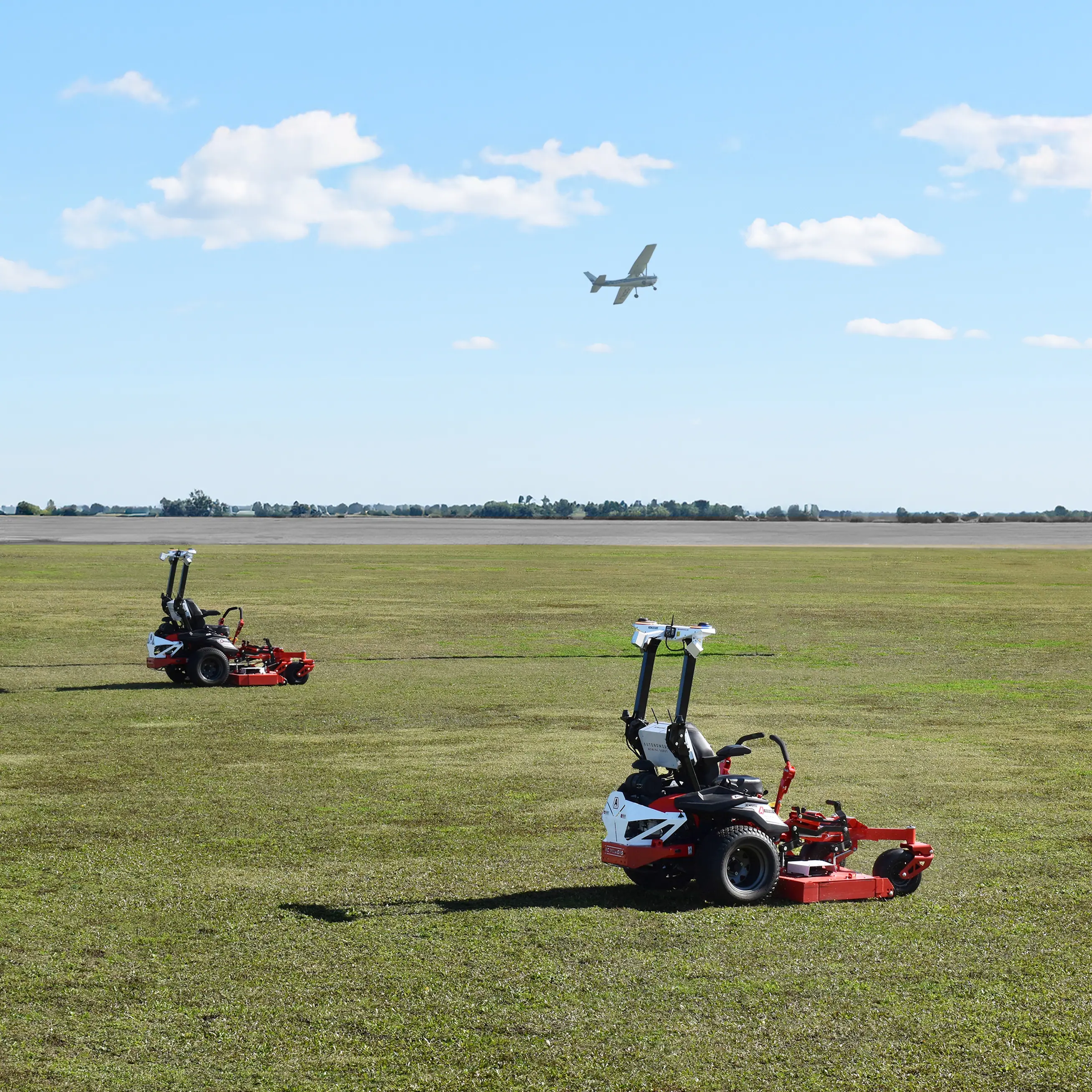
Sugar Land Regional Airport was managing more than 17,000 acres of annual mowing with aging equipment and a stretched maintenance team. Routine grass cutting pulled skilled staff away from higher-priority airport safety and infrastructure work, while rising upkeep costs made the traditional approach increasingly unsustainable.
When Ken joined the Sugar Land Regional Airport in Texas as assistant director of aviation, he inherited a mowing operation stretched thin by aging equipment, rising maintenance costs, and a labor force responsible for maintaining thousands of acres of grass each year.
With 17,000 acres mowed annually and roughly 400 acres turned over every week, mowing had become a necessary but time-consuming task. It routinely pulled skilled maintenance staff away from higher-priority airport safety and infrastructure work.
Ken knew something had to change.
Breaking From the Status Quo
By 2019, the airport’s fleet of traditional mowers ranged from 12 to nearly 20 years old. As reliability declined and upkeep costs climbed, Ken began searching for replacements. Instead of simply upgrading to newer versions of the same machines, he wanted a solution that would fundamentally change how mowing at the Sugar Land Regional Airport was done.
“I was looking for something to break with the status quo. By easing the maintenance burden, we could free up staff to focus on other critical airport priorities.” –Ken D.
Ken spent nearly five years researching autonomous mowing solutions. While several options existed, most were designed exclusively for golf courses or private landscapers and required costly infrastructure or service-based models that did not align with airport operations.
Just as he was preparing to abandon the idea and purchase conventional replacements, Ken came across RC Mowers.
Selecting the Right Solution
What immediately stood out was that RC Mowers offered true autonomy without sacrificing familiarity or control.
Built on a commercial zero turn mowing platform, the RC Mowers A Series fit seamlessly into the airport’s existing maintenance ecosystem. If autonomous systems were ever unavailable, the machines could still be operated manually.
Support also proved to be a key differentiator. RC Mowers provided responsive, hands-on guidance giving Ken confidence that his team, many of whom had no background in advanced technology, could successfully transition to autonomous operations.
“It was status quo plus – Plus the potential for more efficiency.” –Ken D.
Deploying Autonomous Mowing at Scale
The airport deployed three RC Mowers A-60 autonomous mowers and used Real-Time Kinematic (RTK)-enabled GPS guidance and analytics tools and cost analysis platforms to set clear benchmarks. Keeping mowing costs below $13 per acre would make the autonomous approach more cost-effective than traditional methods while saving labor.
During their initial phase, the autonomous mowers averaged 11 to 15 acres per day, with peak days reaching 20 acres. Once sustained production reaches that level, Ken expects a 20 percent labor savings without reducing headcount.
Instead of cutting jobs, those labor hours are redirected toward higher-value tasks such as pavement inspections, runway marking maintenance, and airfield safety initiatives.
Doing Two Jobs at Once
The true impact of autonomous mowing became clear overnight.
While the airport shut down its runway system to clean mildew from runway markings, Ken reassigned his entire crew to the night operation. In the past, that would have meant mowing across the airfield came to a complete halt.
This time, it didn’t.
As crews worked through the night on critical runway maintenance, the autonomous mowers continued cutting grass elsewhere on the airfield — uninterrupted and on schedule.
“In the past, if I moved my whole crew to nights for a week, nobody was mowing. This time, we didn’t lose any ground. We were doing two jobs at once.” –Ken D.
For the first time, overnight infrastructure work no longer came at the expense of routine grounds maintenance. That ability to maintain mowing schedules — even with the entire staff redeployed — became what Ken called the “holy grail” of the project.
Proving Long-Term Operational Value
Ken initially worried that rough terrain, ruts, and wildlife damage across the airfield would limit autonomous performance. Instead, the RC Mowers exceeded expectations, maintaining productivity, stability, and consistent output.
Crew skepticism quickly turned into buy-in as operators gained new technical skills, became specialists in autonomous mowing, and took pride in maintaining and operating the machines.
Today, the program is viewed as a success on every front, from efficiency and safety to labor utilization and long-term cost control.
“They’ve delivered everything they said they would and more. It’s an absolute success story.” –Ken D.
